Five POWRBANK MAX Units Stabilize Power at the F1 Canadian Grand Prix
When Formula 1 comes to Montreal, it brings the world’s fastest cars and a significantly increased electrical demand. At the Circuit Gilles Villeneuve, the 2026 Canadian Grand Prix became a proving ground for large-scale battery energy storage, with five POWRBANK MAX units running in parallel to absorb massive load spikes, stabilize the power grid, and keep every team’s critical equipment online from Friday qualifying through Sunday’s race.
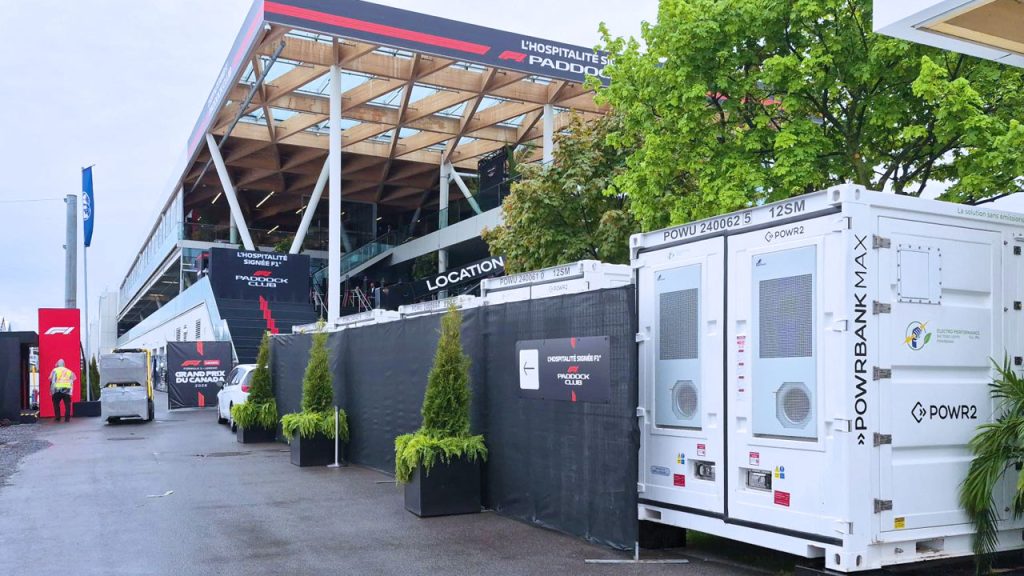
The units were deployed by Electro Performance, POWR2’s Canadian partner, contracted directly by Formula 1 to solve a persistent power challenge at the Montreal circuit. Electro Performance purchased the five POWRBANK MAX units from POWR2 and delivered energy efficiency to one of the most electrically demanding environments in motorsport. The result was a clean, grid-tied commercial energy storage solution that ran 24 hours a day for seven straight days, delivering just over 84 MWh of total energy to the F1 site without a single generator in the system.
Challenge: A Grid Under Pressure
The Circuit Gilles Villeneuve draws power from a Montreal grid connection with a total capacity of about 800 kW. That capacity is sufficient for most of the weekend. The problem comes when every F1 team fires up their tire warmers at the same time.
Tire warmers are the biggest power draw in the F1 paddock. Each team runs units simultaneously, and when the full field prepares for a session, total site load climbs well beyond what the grid can supply. During Friday qualifying, total load pushed to over 900 kW. On race day, with every team running tire warmers at full intensity, it reached 1.1 MW. The load profile is also unusually complex. F1 teams arrive from countries around the world, with equipment operating at different voltages and frequencies, all running through separate step-down transformers. This creates significant electrical harmonics, with frequency readings on the neutral line ranging anywhere from 40 Hz to 130 Hz against an ideal consistent frequency of 50 Hz. Under those conditions, the grid connection would drop out completely, leaving the F1 site without power.
The conventional approach to this problem is to deploy oversized generators with enough output that an unstable load profile becomes irrelevant. It is reliable in a basic sense, but it burns large amounts of diesel, carries significant cost, and produces unnecessary emissions. F1 needed a more efficient answer, and Electro Performance was brought in to provide it.
Solution: Five POWRBANK MAX Units as a Grid-Tied Commercial BESS
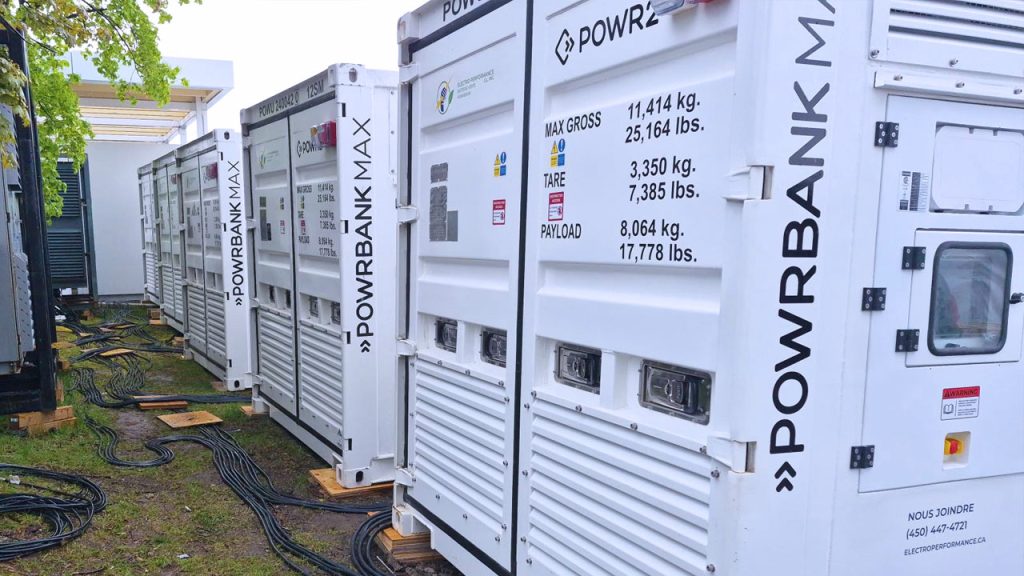
Electro Performance deployed five POWRBANK MAX units in a parallel configuration, connected directly to the Montreal grid with no generators in the power plan. This commercial energy storage solution served two functions at the same time.
Peak Shaving: The grid charged the POWRBANK units at a sustained rate of approximately 750 kW. When the load climbed beyond that during qualifying and race day warm-up periods, the battery energy storage system supplied the difference from stored energy. At the race day peak of 1.1 MW, the units delivered around 400 kW while the grid held steady at 700 kW. The grid stayed within its capacity. The F1 paddock received full, uninterrupted power.
Uninterruptible Power Supply: With the POWRBANK MAX units positioned between the grid and the load at all times, any grid voltage fluctuation was handled internally before it reached the teams. Where the Montreal grid connection had previously failed under similar conditions, the POWRBANKS kept power flowing without interruption. For F1 teams running live telemetry, that continuity is essential to race operations.
The five-unit parallel configuration divided the load evenly. At a typical average draw of 500 to 600 kW, each POWRBANK MAX carried roughly 100 to 120 kW. With 150 kW of grid charge available per unit, the system maintained a balanced state of charge as long as average demand stayed below approximately 750 kW, which it did outside of peak events. At the race day peak of 1.1 MW, net battery drain across all five units was 400 kW, the difference between the 1.1 MW load and 700 kW of grid input. With capacity to sustain that load for over two hours from storage alone, and continuing to charge from the grid throughout, the system had substantial headroom even at the highest demand point of the weekend. In practice, peak periods lasted 30 to 45 minutes until tire warmers reached operating temperature and demand settled.
The scope extended well beyond race sessions. From May 16 through May 24, the five units served as the primary power source for the F1 site. All commercial power from the grid passed through the POWRBANK MAX units first, then out through the transformers and distribution points serving teams, hospitality, and event infrastructure.
Stephen Whitcomb, Team Lead, Technical Support at POWR2, described the setup:
“We provided main power for pretty much anything that was anything at F1, 24/7 from May 16th through May 24th. All commercial power from the grid came to the POWRBANKS first and then through all the many transformers that diverted power to everything.”
On-Site Challenges: Harmonics, Sync, and Getting It Right
The electrical environment at the F1 paddock created challenges beyond a typical commercial job site. The combination of transformers, equipment from dozens of countries, and uneven loads created significant harmonic distortion on the neutral line. With five units running in parallel, those harmonics compounded and caused instability between units. During initial setup, individual POWRBANK MAX units were losing synchronization and dropping offline.
The Electro Performance and POWR2 support team worked through the inverter issue. By tuning the droop control settings, the five-unit array was able to tolerate the abnormal load profile and hold synchronization under live conditions. By race day, the system ran clean with no voltage issues and no sync losses.
Results: Grid Stability, Zero Interruptions, and a New Standard for Event Power
The numbers tell the story and the financial case was straightforward. Without the POWRBANK MAX system, the reliable option for handling the site’s load profile would have been two 1 MW generators running continuously for the full week. Based on the site’s average load of approximately 500 kW, that approach would have consumed an estimated 6,300 gallons of diesel, and at an average of $5.50/gallon for that period in Montreal, total estimated fuel cost would have been $34,650 USD. The grid-tied POWRBANK MAX deployment eliminated that fuel cost entirely.
Whitcomb explained the comparison directly.
“The grid was not able to handle the load in previous years, not just the peak, but the poor quality of the load. [They had] to majorly oversize the generators to handle it. If not for us, they would have had two 1 MW generators running full-time for the whole week. In those terms, we saved them a lot of money.”
Grid Stability & Zero Interruptions
The numbers from the 7-day deployment tell the story clearly.
Key outcomes across the full deployment:
- Grid protection: The Montreal grid connection, capped at approximately 800 kW, was protected from peak loads that reached over 900 kW on Friday and 1.1 MW on race day.
- Zero interruptions: The F1 site experienced no power interruptions at any point across seven days of continuous operation.
- Fuel eliminated: The grid-tied approach replaced a generator only power plan that would have been approximately 6,300 gallons of diesel and $34,650 USD in fuel costs.
- Parallel scalability: Five POWRBANK MAX units coordinated as a single industrial energy storage system, maintaining load balance and grid synchronization under genuinely difficult electrical conditions.
| GENERATOR ONLY SETUP ESTIMATED DATA |
GRID-TIED POWRBANK MAX |
DEPLOYMENT IMPACT |
|
|---|---|---|---|
 FUEL COST
|
$34,650USD
ESTIMATED COST
|
$0
ELIMINATED
|
100%
FUEL COST SAVINGS
|
 FUEL USED
|
6,300GAL.
ESTIMATED DIESEL REQUIRED
|
0GAL.
DIESEL REQUIRED
|
6,300GAL.
DIESEL AVOIDED
|
 EQUIPMENT
SETUP |
2.0MW
TWO 1MW GENERATORS
|
5UNITS
POWRBANK MAX (PARALLEL)
|
1.1MW
PEAK LOAD HANDLED
|
What This Means for the POWRBANK MAX Platform
Being selected by Formula 1 to solve a power infrastructure challenge that conventional approaches had not resolved is a strong validation for Electro Performance and for the POWRBANK MAX platform. Delivering across a full Grand Prix weekend, under real operating conditions, sets a clear benchmark for what commercial battery storage can do at the largest events.
For organizations managing constrained grid infrastructure, the results in Montreal are directly relevant. A battery energy storage system that bridges an undersized grid connection, handles complex industrial loads, and provides seamless UPS protection is a proven, available solution. The POWRBANK MAX is designed for these conditions: high average loads, unpredictable spikes, sensitive equipment, and no margin for downtime. Applications ranging from construction power solutions on sites with limited service capacity to industrial energy storage for facilities with heavy demand peaks fit the same profile as what was solved in Montreal.
Electro Performance continues to grow its commercial energy storage capabilities across Canada, backed by the POWRBANK MAX platform and the performance record built at events like the Canadian Grand Prix. When the grid needs support, the POWRBANK MAX closes the gap.
Conclusion
When the Montreal grid couldn’t keep pace with F1-level demand, five POWRBANK MAX units deployed by Electro Performance delivered 84 MWh over seven days with zero interruptions and zero diesel. The same conditions that made Montreal difficult apply to construction sites, events, and industrial facilities every day: constrained grid capacity, complex loads, and no margin for downtime. If you’re still sizing up generators to cover an undersized service, the numbers from Montreal show there’s a better way.